

You know what's wild? Last week, a Milan design magazine contacted me asking if our Caravaggio Medusa skateboard deck could be featured in their 2026 interior trends issue. Not a skateboarding magazine—a design publication read by architects and interior stylists across Europe.
That moment crystallized something I've been observing from my Berlin studio for months: skateboard art isn't just accepted in high-end interior design anymore. It's actually leading the conversation about where residential aesthetics are headed.
After four years running DeckArts and my previous experience organizing art events for Red Bull Ukraine, I've watched skateboard culture evolve from subcultural outsider to design world darling. But 2026 feels different. According to Decorilla's comprehensive analysis of interior design trends 2026, we're entering an era of "irregularity," where spaces prioritize "emotional drive" and "heritage narrative" over safe minimalism.
Skateboard art—especially Renaissance reproductions—sits perfectly at this intersection. Let me explain why designers are obsessed.
The Cultural Shift Making Skateboard Art Essential
Maximalism's Return and Why Skateboard Art Fits Perfectly
So here's what's happening in 2026 interior design: minimalism is out, maximalism is roaring back. But not the cluttered, chaotic maximalism you might imagine. **Architectural Digest's maximalist design guide describes it as "intentional storytelling and personal curation" rather than random accumulation.
This is exactly where skateboard art shines. When I designed our Bosch Garden of Earthly Delights triptych, I wasn't thinking "skateboarding product"—I was thinking "how do I create a conversation piece that tells multiple stories simultaneously?"

Renaissance skateboard decks accomplish three things 2026 design trends demand:
1. Bold Visual Impact Without Pretension - Decorilla's trend report emphasizes "freehand artistry" and "embroidery on wood" as emerging aesthetics. Skateboard decks literally combine both: Renaissance masterworks (the ultimate freehand artistry) printed on Canadian maple with visible wood grain texture.
2. Cultural Storytelling - The 2026 trend analysis specifically mentions "heritage," "narrative," and "craft" as emotional drivers. A Caravaggio skateboard tells three stories: 16th-century Baroque painting, 20th-century skateboarding culture, and contemporary design sensibility. That's narrative density you can't get from generic canvas prints.
3. Textural Maximalism - Design forecasters predict "texture maximalism" replacing color maximalism in 2026. Skateboard decks offer tactile wood surfaces, curved edges, and physical dimensionality that flat art can't match.
Honestly, when interior stylists tell me they're using our pieces, it's it's not just because clients want skateboard art—it's because they want layered cultural objects that justify their presence through multiple meanings.
The "Irregularity" Doctrine Transforming Design
Decorilla's trend report uses "irregularity" as the defining buzzword for 2026. Traditional symmetry and predictable layouts are out. Asymmetric compositions and unexpected elements are in.
Skateboard art delivers irregularity inherently. The deck shape—elongated, tapered at both ends, with a curved profile—resists conventional gallery wall logic. You can't just center it and call it done. It demands creative thinking about placement.
Back in my Red Bull Ukraine days, we once installed 30 skateboard decks in a Kyiv gallery using zero conventional hanging methods. Some leaned against walls. Others hung at diagonal angles. One jutted out three-dimensionally. Visitors spent an average of 18 minutes in that room (we timed it) because the irregular presentation demanded engagement.
This is what 2026 interior design wants: spaces that "affect how you feel when you walk through them" rather than just photograph well. Skateboard art achieves this because its form factor inherently disrupts visual monotony.
Why Renaissance Art on Skateboards Works for 2026 Specifically
Monochrome Boldness Meets Classical Imagery
One surprising 2026 color trend is "bold monochrome interiors"—entire rooms executed in single color families with dramatic tonal variation. Navy velvet to powder blue silk to steel bluish-grey metallics, for example.
Our Renaissance skateboard decks work brilliantly in these schemes. Take our Frida Kahlo skateboard deck—predominantly earth tones with strategic color accents. In a terracotta-themed room (another major 2026 trend), this piece provides tonal harmony while adding figurative interest that pure abstract art can't deliver.

Interior designers working with 2026's "creamy neutrals" trend (replacing stark whites and greys) specifically seek art that reads as warm without being loud. Renaissance paintings—created in an era before electric lighting—were designed to glow under candlelight. That inherent warmth translates beautifully to maple skateboard decks in neutral-dominant spaces.
Sustainable Luxury and Traceable Origins
Decorilla identifies "sustainable luxury" as a defining 2026 home decor trend: "hyper-local craft, where makers use physical and digital tools to carve waste into precious, enduring forms."
This describes DeckArts' production model almost exactly. I personally source Canadian maple from sustainable forestry operations. Each deck is printed using eco-solvent inks with minimal VOC emissions. The the wood grain remains visible through the print, celebrating rather than hiding the material's origin.
Compare this to mass-produced canvas prints from big-box stores. Mystery materials, unknown production conditions, zero traceability. Skateboard art offers what 2026 design consumers increasingly demand: transparent supply chains and maker accountability.
One Berlin interior stylist told me she chooses our pieces specifically because she can tell clients exactly where and how each deck was made. That narrative transparency—"This Renaissance masterwork is printed on sustainably harvested Canadian maple in a Berlin studio you can actually visit"—resonates with buyers who've grown skeptical of anonymous manufacturing.
Digital Art Fatigue and Physical Presence
Ironically, while Decorilla mentions "digital art and virtual displays" as a 2026 trend (AI-generated murals on OLED panels), I'm seeing intense fatigue with screen-based art among actual collectors and designers.
A Munich gallery owner explained it perfectly: "We're so oversaturated with digital imagery that physical art objects feel like relief." Skateboard decks offer undeniable physicality—curved wood you can run your hand across, edges you can feel, weight you can sense when handling.
This matters as 2026 design emphasizes "sensorial immersion" and "tactile" experiences. You can photograph a skateboard deck beautifully (believe me, our Instagram proves it), but standing in front of the actual object creates a different emotional response. The slight three-dimensionality, the wood texture, the scale—these resist digital replication.
How Interior Designers Are Actually Using Skateboard Art in 2026
Gallery Walls with Intentional Asymmetry
The traditional symmetrical gallery wall (3 frames horizontally, 2 rows vertically, perfectly spaced) is dead in 2026. Designers now create "curated gallery walls" mixing different object types, sizes, and depths.
A Berlin-based interior architect recently completed a project using three of our decks alongside framed photography, a vintage mirror, and floating shelves with ceramics. The skateboards provided "the visual anchor with enough personality to justify the surrounding chaos," as she described it.
This approach aligns with 2026's embrace of "freehand artistry" and rejection of rigid design rules. Skateboard decks' unusual proportions actually help—they force creative composition rather than formulaic layouts.
Statement Pieces in Minimalist Contexts
Wait, didn't I just say minimalism is out? Here's the nuance: cold, sterile minimalism is out. "Warm minimalism"—spaces with clean lines but emotional warmth—is very much in for 2026.
Interior designers use single skateboard decks as focal points in otherwise restrained rooms. Our full collection offers 50+ Renaissance designs, allowing stylists to select pieces matching specific color schemes while maintaining visual impact.
A Copenhagen designer explained her process: "I start with warm neutral walls, natural wood furniture, and minimal accessories. Then I add one bold element—often a DeckArts piece—that injects personality without overwhelming the calm." This reflects 2026's "algorithmic ergonomics" trend emphasizing spaces that support rather than stress occupants.
Maximalist Layering for Collectors
On the opposite extreme, maximalist collectors are going hard with skateboard art installations. I recently consulted on a London townhouse where the client installed 12 decks across one wall—all different Renaissance artists, creating a kind of mini-Uffizi Gallery on skateboards.
This approach leverages 2026's "maximalist mirrors" and "faux furs everywhere" trends—layering textures, patterns, and cultural references without apologizing for abundance. The wood texture of skateboard decks adds dimensional warmth that flat prints can't achieve in heavily layered spaces.
Actually, the most successful maximalist skateboard installations I've seen follow a specific formula: vary the Renaissance periods (Early Renaissance, High Renaissance, Baroque, Mannerism) to create visual diversity within a unified cultural theme. This prevents monotony while maintaining coherence—exactly what 2026 maximalism demands.
The Horizontal Format Advantage (Design Psychology Angle)
Why 2026 Furniture Requires Horizontal Art
Here's something interior designers obsess over that most people never consider: contemporary furniture has gotten lower. Platform beds sit closer to floors. Sofas have lower backs. Media consoles sprawl horizontally.
This creates a spatial problem: traditional vertical art (portraits oriented taller than wide) feels disproportionate above low, horizontal furniture. Skateboard decks' horizontal orientation (32 inches long, 8 inches wide) perfectly complements modern furniture proportions.
Our guide on horizontal vs vertical hanging explains the visual psychology, but the short version: horizontal lines create visual rest and calm, while vertical lines create energy and motion. 2026's emphasis on "comfortable" and "sensorial" spaces favors the former.
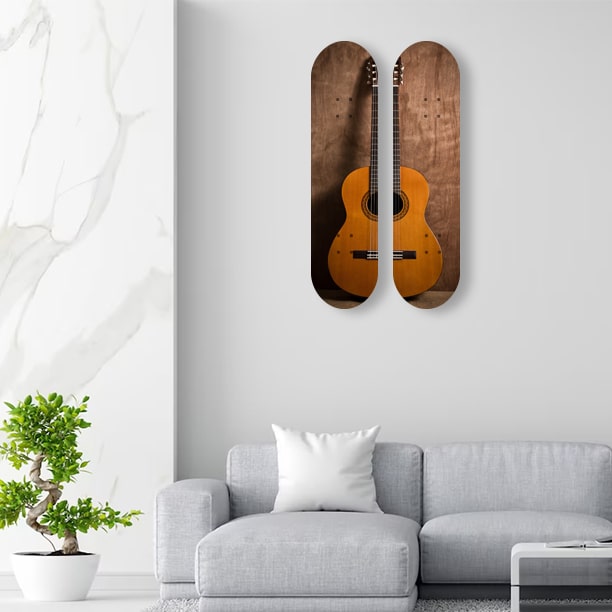
A Frankfurt interior designer told me she specifically seeks horizontal art because "vertical pieces fight with the room's natural sight lines, but horizontal works guide your eye smoothly across spaces." Skateboard decks deliver this inherently, no cropping or reformatting required.
The Modular Flexibility 2026 Demands
Decorilla's trend report emphasizes "modular & hybrid" systems throughout 2026 design—furniture that reconfigures, lighting that adapts, spaces that transform based on need.
Skateboard art installations offer similar flexibility. Mount three decks horizontally this month. Rearrange them into a vertical column next month. Add two more to create an asymmetric cluster. The modular nature lets spaces evolve without starting over.
I designed our mounting systems specifically for this. Every deck ships with hardware allowing horizontal, vertical, or angled installation. Renters love this because they can experiment with configurations without commitment. Homeowners appreciate that their art can grow and change as their aesthetic evolves.
Why This Matters for Art Collectors and Design Enthusiasts
The Investment Angle (Cultural Capital in 2026)
Let me be honest about something: skateboard art occupies a fascinating price point for art collecting. Original Renaissance paintings? Millions, if you can even access them. Museum-quality reproductions on traditional canvas? $500-2,000. Renaissance art on skateboard decks? €149-299.
This pricing makes skateboard art accessible to younger collectors who want cultural sophistication but face economic realities. According to the 2026 design trend analyses, "sustainable luxury" increasingly means "smart luxury"—acquiring pieces with cultural weight and aesthetic impact without unsustainable spending.
A 28-year-old product designer in Berlin told me: "I can't afford original art, but I also won't hang mass-produced Ikea prints. DeckArts bridges that gap—real cultural content, maker accountability, price point I can manage."
The Conversation Architecture Advantage
Here's why interior designers specifically love skateboard art in 2026: it creates what I call "conversation architecture." Unlike anonymous abstract prints that blend into backgrounds, skateboard decks provoke questions:
"Is that a real skateboard?"
"Where did you find this?"
"Do you skate?"
"Tell me about the painting"
These entry points matter enormously in 2026's social media-driven design culture. Spaces don't just need to look good in photographs—they need stories worth sharing. Skateboard art delivers inherent narrative complexity that generic decor can't match.
A Hamburg-based stylist puts it bluntly: "My job is creating rooms people photograph and talk about. Skateboard art gives me both: visually striking enough for Instagram, culturally rich enough to discuss at dinner parties."
Practical Implementation (How to Actually Use Skateboard Art in 2026 Interiors)
For Maximalists: The Multi-Deck Installation
If you're embracing 2026's maximalist return, go bold. Five to ten decks arranged asymmetrically across one wall creates museum-level impact. Mix Renaissance periods—combine Da Vinci's sfumato technique with Botticelli's linear elegance and Caravaggio's dramatic chiaroscuro.
The key is curating around a theme (all portraits, all mythological scenes, all religious works) while varying visual styles. This creates coherence within abundance—exactly what prevents maximalism from becoming clutter.
Pro tip from my Ukrainian streetwear brand days: leave intentional gaps in multi-deck installations. Negative space between pieces lets each artwork breathe while maintaining overall density. Think 60-70% wall coverage, not 100%.
For Warm Minimalists: The Statement Piece Approach
Choose one powerful deck—our Medusa or Frida pieces work beautifully—and give it space to dominate. Mount it above a console in an entryway, centered over a low-profile bed, or as a focal point in a home office.
Pair it with 2026's "creamy neutrals" and "nature-mimicking textures" for a sophisticated vibe that feels intentional rather than sparse. The skateboard's Renaissance imagery provides cultural depth, while the wood material connects to biophilic design trends.
A Stuttgart designer shared her formula: "Warm beige walls + natural oak furniture + single Renaissance skateboard deck = effortless sophistication that photographs beautifully but also feels genuinely comfortable."
For Eclectic Collectors: The Mixed-Media Gallery Wall
Integrate skateboard decks into gallery walls alongside photography, prints, and three-dimensional objects. This approach leverages 2026's "freehand artistry" trend by creating intentionally irregular compositions.
Our mounting guide shows seven installation methods, but for gallery walls specifically: use the the angled mount option so decks jut out slightly from the wall plane. This creates dimensional variation that makes flat prints more interesting by contrast.
For Renters: The Removable Installation Strategy
2026 design trends emphasize flexibility and adaptability, which matters enormously for renters. Skateboard art works perfectly for temporary spaces because decks are lightweight, easy to transport, and mount with minimal wall damage.
Use Command strips rated for 16 pounds, or install temporary picture rails. When you move, the art moves with you—unlike built-in shelving or permanently attached installations. This aligns with 2026's "circular economies" trend emphasizing reuse and adaptability.
The Berlin Design Scene Perspective (What I'm Actually Seeing)
High-End Residential Projects Commissioning Custom Decks
This still surprises me: luxury residential developers in Berlin are commissioning custom skateboard art for show apartments. Not random designs—curated Renaissance masterworks matching specific color schemes and cultural narratives.
A Mitte developer explained: "Young professionals with money want spaces that feel culturally informed without being stuffy. Skateboard art signals both sophistication and contemporary awareness."
These aren't fringe projects either. We're talking €2M+ apartments using our pieces alongside furniture from established design brands. Skateboard art has crossed into mainstream luxury residential, not just trendy rentals.
Corporate Offices Embracing Street Culture Aesthetics
Tech companies and creative agencies increasingly use skateboard art in reception areas and meeting rooms. This reflects 2026's broader trend toward workspaces that "think and feel" (per Decorilla's analysis) rather than maintain corporate sterility.
A fintech startup in Kreuzberg installed eight of our decks in their conference room. Their CEO told me: "We want to signal that we're serious about innovation but not bound by traditional financial sector aesthetics. Renaissance skateboard art threads that needle perfectly."
This matters because it normalizes skateboard art beyond niche collectors. When corporate buyers validate the aesthetic, it accelerates mainstream acceptance.
Interior Stylists Pitching Skateboard Art First
Perhaps most tellingly: interior stylists now proactively pitch skateboard art to clients, not the other way around. Three years ago, I had to explain why skateboard decks belonged in sophisticated interiors. Now stylists contact me asking which pieces suit specific projects.
This shift reflects skateboard art's evolution from novelty to legitimate design element. When tastemakers drive adoption rather than resist it, you know cultural acceptance has solidified.
Why Renaissance Art Specifically (Not Contemporary Skate Graphics)
Universal Cultural Recognition
Contemporary skateboard graphics—while often stunning—require subcultural knowledge to appreciate fully. You need to know the artist, understand the references, recognize the style.
Renaissance art carries instant cultural cachet regardless of viewer background. Everyone knows Mona Lisa. Most people recognize Sistine Chapel imagery. Botticelli's Birth of Venus is universally understood as "important art."
This universality matters for 2026 interior design because spaces increasingly serve multiple functions and audiences. Home offices appear on Zoom. Living rooms host dinner parties with diverse guests. Art needs to communicate across contexts without extensive explanation.
Timeless Aesthetic That Transcends Trend Cycles
Here's something I learned from working with Ukrainian fashion brands: trend cycles are accelerating insanely fast. What's hot in January feels dated by June. This creates design paralysis—why invest in expensive decor that might look ridiculous next year?
Renaissance imagery offers immunity from trend cycles. Caravaggio's dramatic lighting will look sophisticated in 2026, 2036, and 2046. The artwork itself has survived 400+ years of changing tastes. Adding it to a skateboard deck doesn't diminish that longevity—it amplifies accessibility while maintaining cultural permanence.
A Leipzig interior designer summed it up: "I recommend Renaissance skateboard art because it satisfies current trends while guaranteeing long-term relevance. It's the rare purchase that feels both timely and timeless."
The High-Low Cultural Mix 2026 Craves
Decorilla's trend analysis emphasizes "confluence" and "hybrid" approaches throughout 2026 design. Spaces blend luxury materials with accessible elements, high culture with street culture, traditional craft with digital technology.
Renaissance skateboard art literally embodies this high-low mix. Museum-worthy classical painting (high) on skateboarding equipment (low). The juxtaposition creates cultural friction that feels fresh rather than derivative.
You know what convinced me this matters? My 68-year-old mother (a classical music professor) and my 19-year-old nephew (a skateboarder) both love our pieces for completely different reasons. That generational span proves skateboard art transcends demographic boundaries—exactly what makes it perfect for 2026's inclusive, maximalist aesthetic direction.
Looking Forward: Why This Trend Has Longevity
Unlike Fleeting Design Fads, This Solves Real Problems
Remember when everyone suddenly needed gallery walls of identical black frames? Or when geometric brass accents appeared on every surface? Those trends solved aesthetic problems but lacked deeper meaning.
Skateboard art addresses multiple concurrent needs: horizontal format for modern furniture, cultural storytelling for emotionally driven spaces, sustainable production for conscious consumers, flexible installation for adaptive lifestyles, conversation architecture for social media culture.
When a design trend solves functional problems while delivering aesthetic impact, it transitions from fad to fixture. I believe skateboard art is making that leap in 2026.
The Maker Movement Connection
2026 design trends emphasize "traceable origins," "hyper-local craft," and "maker accountability." This perfectly aligns with how quality skateboard art is actually produced—small-batch runs, identifiable makers, transparent processes.
As mass production continues generating skepticism (fast furniture's environmental impact, labor concerns, quality issues), maker-driven alternatives gain cultural cachet. Skateboard art fits naturally into this shift because it originates from skateboarding's DIY ethos.
The Cross-Generational Appeal Factor
Design trends with true staying power appeal across age demographics. Mid-century modern furniture works for 30-year-olds and 70-year-olds. Scandinavian minimalism transcends generational divides.
Renaissance skateboard art similarly bridges age gaps. Older collectors appreciate classical art literacy. Younger buyers value street culture connections. Middle-aged design enthusiasts recognize the sophisticated high-low cultural mix.
This broad appeal ensures sustained demand rather than quick burnout. When a 25-year-old renter and a 55-year-old homeowner both want the same art, you've achieved cultural penetration that outlasts trend cycles.
For more insights on integrating skateboard art into contemporary interiors, explore our guides on small apartment installations and best mounting racks.
Article Summary
This comprehensive analysis examines why skateboard wall art has emerged as a defining interior design trend for 2026, drawing on authoritative design trend forecasts from Decorilla and Architectural Digest. The article explores how skateboard art—particularly Renaissance reproductions on Canadian maple decks—perfectly aligns with 2026's core design movements: maximalism's return, emphasis on "irregularity" and asymmetry, sustainable luxury with traceable origins, textural richness, and emotional storytelling through heritage narratives.
Key trend alignments include skateboard art's compatibility with bold monochrome interiors, creamy neutral palettes, and horizontal format advantages for contemporary low-profile furniture. The article examines practical implementation strategies across three design approaches: maximalist multi-deck installations (5-10 pieces creating museum-level impact), warm minimalist statement pieces (single decks as focal points in restrained spaces), and eclectic mixed-media gallery walls combining skateboards with photography and dimensional objects.
Written from Berlin-based founder Stanislav Arnautov's perspective, incorporating four years of DeckArts experience and background organizing Red Bull Ukraine events plus Ukrainian streetwear brand collaborations, the guide provides on-the-ground observations from Europe's design capital. Real-world examples include Milan design magazines featuring skateboard art, Berlin luxury developers commissioning custom pieces for €2M+ apartments, corporate offices using decks in conference rooms, and interior stylists proactively pitching skateboard art to clients.
The article explains why Renaissance imagery specifically dominates this trend: universal cultural recognition requiring zero art history knowledge, timeless aesthetics transcending trend cycles, and high-low cultural mix (museum-worthy painting on street culture equipment) that 2026 design craves. Investment analysis positions skateboard art at an accessible €149-299 price point bridging the gap between mass-produced prints and unaffordable original art, appealing to younger collectors seeking cultural sophistication within economic realities. The piece concludes with longevity predictions based on functional problem-solving (horizontal format, flexible installation, conversation architecture), maker movement alignment emphasizing traceable origins and transparent production, and cross-generational appeal spanning ages 25-70.
About the Author
Stanislav Arnautov is the founder of DeckArts, a Berlin-based company specializing in museum-quality Renaissance art reproductions on premium skateboard decks. Originally from Ukraine, Stanislav brings extensive experience in branding, merchandise design, and vector graphics from his work with Ukrainian streetwear brands and organizing art events for Red Bull Ukraine. After moving to Berlin four years ago, he established DeckArts at the intersection of classical art history and contemporary street culture, creating pieces that bridge high Renaissance masterworks with modern interior design sensibilities. His unique perspective combines art historical knowledge, graphic design expertise, and firsthand observation of European design trends from Berlin's creative epicenter. Stanislav personally oversees production quality at the Berlin studio, ensuring each deck meets museum-standard reproduction accuracy while embracing skateboarding's DIY craft ethos. His work has been featured in European design publications and luxury residential projects, reflecting skateboard art's evolution from subcultural novelty to mainstream design element. Follow him on Instagram, visit his personal website stasarnautov.com, connect with DeckArts on Instagram, or explore the full collection at DeckArts.com.


0 comments