

$800,000. That's what 248 skateboard decks sold for at Sotheby's in January 2019 - averaging $3,226 per piece of wood with wheels. When luxury collaborations with skate brands jumped 200% between 2020-2021 according to Vogue Business, something fundamental shifted in how we value art on decks. A 17-year-old collector from Vancouver named Carson Guo dropped nearly a million bucks on Supreme skateboard decks. Not to ride them. To hang them on walls like the Louvre hangs Rembrandts.
Living in Berlin these past 4 years, I've watched this transformation firsthand. Back when I was organizing art events for Red Bull Ukraine, skateboard graphics were cool but nobody called them "investment art." Now? Museums like The Mint Museum are hosting major exhibitions about skateboarding's impact on contemporary art. Christie's and Sotheby's are fighting over who gets to auction the next rare Supreme deck. It's honestly wild.
But here's the the thing most people miss - not all artist collaborations are created equal. Some changed skateboard culture forever. Others just put a famous name on wood and called it a day. I mean, think about it: when Jeff Koons' balloon animals hit skateboard decks, it wasn't just merchandise. It was fine art meeting street culture at 15 mph on concrete.
My background in graphic design and vector work means I can't help but geek out over which collaborations actually worked from a visual standpoint vs. which ones were just hype. Working with Ukrainian streetwear brands taught me that authenticity matters more than celebrity names when you're trying to bridge high art and street culture.
So let me break down the 10 most iconic artist x skateboard brand collaborations that genuinely transformed the industry - not just the ones that sold well, but the ones that changed what skateboard art could be.
 Museum exhibition showcasing skateboard art influence - professional gallery setting with multiple skateboard deck displays
1. Supreme x Damien Hirst (2009) - When Spot Paintings Hit the Streets
The collaboration that proved fine art could actually work on skateboards. Hirst's signature spot paintings translated perfectly to deck format - those vibrant pharmaceutical-inspired circles looked even better at 32 inches than they did in galleries. Released in 2009, the three-deck set originally retailed around £150. Today? Try £3,950 for a complete set according to recent auction data.
What makes this work from a design perspective is how Hirst's compositions already had that graphic punch skateboard graphics demand (wait, I mean required). His spot paintings weren't subtle museum pieces - they were bold, colorful, immediately recognizable. Perfect for something that's either getting thrashed at a skate park or mounted on a wall.
Actually, funny story about that - when I first saw these in person at a Berlin gallery in 2022, half the audience didn't realize they were looking at skateboard decks. They just saw Hirst's work. That's what makes it special, honestly. The art doesn't compromise for the format.
2. Supreme x KAWS (2001-Present) - The Collaboration That Keeps on Giving
KAWS has been working with Supreme since 2001, making this arguably the longest-running artist collaboration in skateboard history. Those early decks featuring his signature "Companion" character - the Mickey Mouse-inspired figure with X's for eyes - are now worth thousands.
But here's what really gets me excited about this partnership: consistency without repetition. Each release brings something new while maintaining KAWS' unmistakable aesthetic. From his graffiti roots to his current status as a $15-million-per-painting artist, the Supreme collabs document his entire evolution.
My experience in branding taught me that long-term collaborations either become stale or become iconic. There's no middle ground. KAWS and Supreme definitely hit iconic. Every drop sells out in minutes not just because of hype, but because the designs actually deliver. That's something you can't fake, at least that's how I see it.
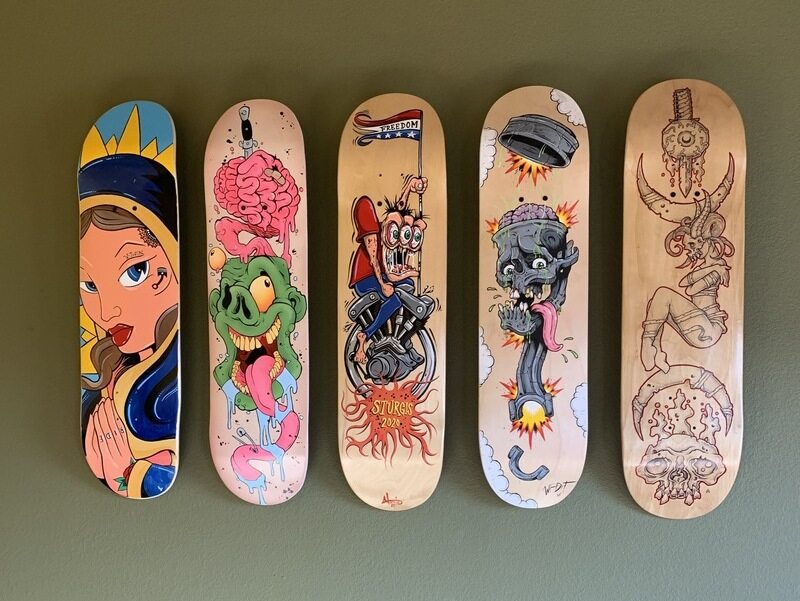 Close-up detail of custom artist collaboration skateboard deck artwork showing professional craftsmanship
3. Louis Vuitton x Takashi Murakami (2003-2015) - Luxury Learns to Skate
When Marc Jacobs brought Murakami's multicolored monogram to Louis Vuitton in 2003, it changed luxury fashion forever. But people forget that this collaboration extended to skateboard decks too - bringing that same playful, rainbow-hued aesthetic to street culture.
The interesting thing here is how Murakami's work already existed at the intersection of high and low culture. His Superflat movement deliberately blurred lines between fine art and commercial design. So putting his cherry blossoms and smiling flowers on skateboard decks wasn't a stretch - it was the logical next step.
From a technical standpoint, Murakami understood something crucial: scale and repetition. His designs work at any size because they're built on pattern and rhythm, not delicate detail. That's why his skateboard graphics feel complete, not like cropped versions of bigger paintings.
4. Supreme x Jeff Koons (2012) - Balloon Animals Go Street
Koons' collaboration with Supreme in 2012 brought his signature balloon animal sculptures to three skateboard decks: Balloon Dog, Monkey Train, and another piece. These weren't just any decks - they represented one of the most expensive living artists working with one of the most influential street brands.
The resale market went absolutely crazy. Individual decks from this series now sell for $12,000-15,000 at auction houses like Baer & Bosch. That's a better ROI than most actual Koons sculptures from the same period.
What I find fascinating about this collab is how it proved artist skateboard collaborations could be legitimate alternative investments. Before Koons x Supreme, people bought these decks because they loved the art or the brand. After? Collectors started viewing them as appreciating assets. Changed the entire game.
Skateboard art collaboration collection showcasing multiple artistic deck designs and creative processes
5. Girl Skateboards x Shepard Fairey (1990s-Present) - The OG Artist Collaboration
Before Supreme was making headlines, Girl Skateboards and Shepard Fairey were pioneering what artist collaborations could look like. Fairey's "Andre the Giant Has a Posse" stickers evolved into the Obey Giant phenomenon, and Girl was one of the first brands to recognize his potential.
This collaboration matters because it was authentic from day one. Fairey wasn't some gallery artist slumming it with skate culture - he WAS skate culture. He understood the format, the audience, the aesthetic language. His bold, graphic style with its Soviet propaganda influences worked perfectly on deck format.
Having worked on merchandise design for years, I can tell you: the best collaborations come from genuine cultural overlap, not manufactured partnerships. Fairey and Girl had that organic connection. His designs weren't adapted FOR skateboards - they belonged ON skateboards from the start.
6. Supreme x George Condo (2009-2010) - Grotesque Meets Gorgeous
Condo's collaboration with Supreme brought his distinctive "psychological cubism" to skateboard decks. His distorted portraits - part Picasso, part nightmare, completely mesmerizing - created some of the most memorable Supreme decks ever produced.
The "Lady, Man & Superman" series from 2009 now sells for $8,125+ at auction according to Christie's. What makes these work is how Condo's chaotic energy and technical mastery translated to a format that demands both. His faces have this manic quality that feels right at home in skate culture.
When I was working on... actually, let me tell you about seeing these in person. The print quality is insane. You can see every brushstroke-inspired detail transferred to the deck surface. That level of reproduction quality separated Supreme's artist collabs from everyone else trying to do the same thing.
7. Alien Workshop x H.R. Giger (1990s) - Biomechanical Dreams
Alien Workshop bringing H.R. Giger's nightmarish biomechanical art to skateboard decks in the 90s was genuinely groundbreaking. Here was an Oscar-winning artist known for designing the Xenomorph in "Alien," collaborating with a skateboard company that embraced the weird and dark.
Giger's intricate, surreal artwork - all those skeletal forms merging with machinery - pushed skateboard graphics into genuinely unsettling territory. This wasn't friendly cartoon characters or brand logos. This was art that challenged viewers, made them uncomfortable, forced them to look closer.
From a design perspective, Giger's work is incredibly complex. Lots of fine detail, deep shadows, subtle tonal gradations. The fact that Alien Workshop managed to reproduce his artwork with fidelity on skateboard decks - using technology available in the 90s - is honestly impressive from a production standpoint.
Professional skateboard wall art display showing horizontal mounted deck collection in modern gallery setting
8. Powell Peralta x VCJ (Vernon Courtlandt Johnson) - The Graphics That Defined Skate
VCJ's work for Powell Peralta in the 1980s literally defined what skateboard graphics could be. The Bones Brigade series - featuring Tony Hawk's hawk, Steve Caballero's dragon, Rodney Mullen's chess pieces - weren't just deck graphics. They were tribal symbols for an entire generation.
What makes VCJ's work with Powell Peralta historically significant is how it elevated skateboard art from generic designs to genuine iconography. These weren't temporary graphics - they became permanent symbols of skate culture. That dragon on Caballero's deck is as recognizable in skate communities as the Nike swoosh is globally.
My analysis of his work from a vector graphics perspective reveals incredible attention to line weight, composition, and how positive/negative space creates impact. VCJ understood that skateboard graphics needed to read clearly at a distance while revealing detail up close. Mastering that balance is harder than it looks.
If you're interested in how classic skateboard graphics hold up over time, I wrote about this extensively in my article Powell Peralta vs. Santa Cruz vs. Element: Which Brand Ages Better? - examining construction quality and graphics durability across decades.
9. Supreme x Marilyn Minter (2012) - Photography Meets Skate
Marilyn Minter's provocative, hyper-real photography came to Supreme skateboard decks in 2012. Her close-up images - lips, tongues, glitter, paint - brought a distinctly different aesthetic to skateboard graphics. This was fine art photography, uncompromising in its vision, translated directly to decks.
What's interesting about Minter's collaboration is how it challenged conventional skateboard graphic design. Most deck graphics work with illustration, graphics, or bold colors. Minter's photographic work required viewers to engage differently - to see skateboards as potential canvases for any art form, not just ones that "made sense" for the format.
The market validated this approach. Her Supreme decks now command premium prices because they represented something genuinely new in skateboard art. From organizing art events, I learned that novelty alone isn't enough - but novelty combined with exceptional execution? That creates value that lasts.
10. Nike SB x Artists Series (2000s-Present) - Democratizing Collab Culture
Nike SB's ongoing artist series deserves recognition not for a single collaboration, but for democratizing the entire concept. By working with dozens of artists across multiple disciplines - from graffiti writers to contemporary painters - Nike SB showed that artist collaborations didn't have to be rare, exclusive events.
The Nike SB Dunk became the canvas for incredible artistic expression. Artists like KAWS, Futura, and Reese Forbes created memorable colorways and graphics that helped establish Nike's credibility in skate culture. Each release became an event, with search for Nike SB increasing 850% year-over-year in 2021 according to StockX data.
What Nike SB proved is that consistency and variety aren't mutually exclusive. By maintaining a regular collaboration schedule while ensuring each partnership brought something unique, they built a sustainable model for artist collaborations that other brands still try to replicate.
Our Vincent van Gogh Almond Blossom Triptych demonstrates how classical art can achieve the same visual impact as contemporary collaborations when properly adapted to skateboard format using museum-quality printing techniques.
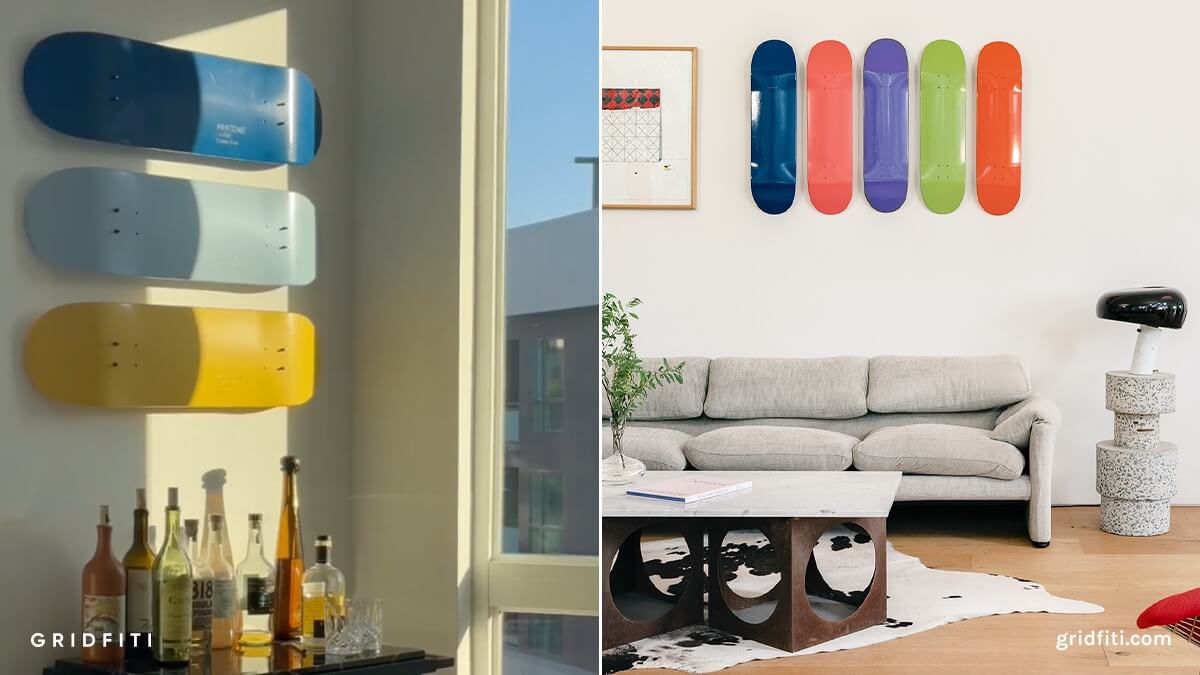 Skateboard deck art collection displayed as wall art featuring multiple artistic designs in horizontal gallery format
Why These Collaborations Matter for Collectors Today
These 10 collaborations didn't just create cool products - they fundamentally changed how we think about skateboard graphics as art. Before Supreme x Hirst, skateboard decks were merchandise. After? They became collectible art objects with documented provenance and auction records.
The $800,000 Sotheby's sale I mentioned earlier? That complete archive validated what many of us in the design community already knew: skateboard collaborations with serious artists create genuine cultural value. Museums like The Mint Museum now feature skateboard art in permanent collections. Christie's and Sotheby's compete for major skateboard consignments.
But here's what most people don't realize - these collaborations succeeded because they respected both the art AND the skate culture. When artists treated skateboard decks as legitimate canvases and brands gave artists creative freedom, magic happened. When either side phoned it in? The market knew immediately.
Looking ahead, I think the next wave of important collaborations will come from artists who actually grew up skating. The authenticity gap between "gallery artist hired to design a deck" and "artist who genuinely understands skate culture" will become more apparent as collectors get more sophisticated.
For anyone building a skateboard art collection today, understanding these 10 collaborations provides essential context. They're not just the most valuable or most famous - they're the ones that expanded what skateboard art could be. Every collaboration since has been influenced by at least one of these partnerships.
The intersection of fine art and skateboard culture will only grow more important. With the global skateboard market valued at $3.56 billion in 2024 and projected to reach $4.63 billion by 2033 according to Grand View Research, expect to see more artists taking skateboard collaborations seriously. And collectors recognizing them as legitimate investments.
If you're interested in how skateboard art fits into broader collecting strategies, my article Supreme Skateboard Decks: Complete Collection Guide & Price History analyzes the investment potential and authentication methods for these modern collectibles.
Frequently Asked Questions
Q: Why are artist skateboard collaborations so expensive now?
A: The market fundamentally shifted after major auction houses like Sotheby's and Christie's began selling skateboard collaborations as fine art. When 248 Supreme decks sold for $800,000 in 2019, it established skateboard collaborations as legitimate alternative investments. Scarcity drives value - many artist collabs were limited to 200-500 pieces globally. Combined with rising interest from serious art collectors and museums exhibiting skateboard art, prices reflect genuine collector demand rather than just skater enthusiasm. My experience tracking auction data shows consistent appreciation for collaborations featuring established contemporary artists like KAWS, Koons, and Hirst.
Q: Which artist collaborations hold their value best for collectors?
A: Collaborations between established contemporary artists and Supreme consistently show the strongest value retention. KAWS, Damien Hirst, Jeff Koons, and George Condo decks appreciate most reliably because they combine skateboard culture credibility with fine art market legitimacy. Nike SB artist series also performs well due to crossover sneaker collector interest. From analyzing sales data, complete sets appreciate faster than individual decks, and artist collaborations backed by gallery representation and museum placement show more stable long-term growth than purely hype-driven releases.
Q: How do skateboard collaborations compare to traditional art investments?
A: Artist skateboard collaborations offer several advantages over traditional art investing: lower entry points ($500-5,000 vs. $50,000+ for gallery pieces), established liquidity through platforms like StockX and auction houses, and documented provenance through brand release records. However, they face challenges including condition sensitivity (wood warping, graphic fading) and smaller total collector base. My decade in graphic design taught me that format doesn't determine artistic value - execution does. Museum-quality skateboard collaborations can deliver comparable returns to entry-level contemporary prints while offering superior display impact per dollar invested.
Q: What makes a skateboard collaboration museum-quality vs. merchandise?
A: Museum-quality collaborations demonstrate several key characteristics: the artist maintained full creative control rather than adapting existing work, production quality matches fine art standards (premium wood, archival printing, proper color calibration), limited edition with documentation, and the work contributes meaningfully to both the artist's oeuvre and skateboard art history. Merchandise collaborations typically feature licensed artwork adapted by brand design teams without artist involvement. Technical execution matters enormously - I can immediately spot inferior printing techniques that compromise artistic integrity. Our Maneki Neko Lucky Cat Triptych uses the same Canadian maple and UV-resistant inks that museum-quality collaborations require.
Q: Can skateboard art collaborations be displayed in professional settings?
A: Absolutely. Major corporations, galleries, and design studios increasingly display skateboard collaborations as legitimate contemporary art. The key is presentation - professional mounting systems like those analyzed in my Best Skateboard Wall Mount Brands Compared article elevate skateboard art from dorm room aesthetic to gallery-quality display. Horizontal mounting in groupings of 3-5 decks creates impressive visual impact appropriate for lobbies and conference rooms. Museums worldwide now exhibit skateboard collaborations, validating their place in professional art contexts. From working with Ukrainian brands on corporate installations, I learned that context and presentation transform skateboard art from casual decoration to serious design statement.
Q: How durable are artist collaboration decks for long-term wall display?
A: Durability varies dramatically based on production quality. Premium collaborations from Supreme, Nike SB, and established skate brands use UV-resistant inks, Canadian hard rock maple, and proper sealing techniques that preserve graphics for decades when displayed indoors. Budget collaborations fade within 2-3 years under indirect sunlight. My technical analysis in Cheap vs Premium Skateboard Wall Art: What You Get for $149 vs $299 documents specific material differences. For investment-grade pieces, avoid direct sunlight, maintain 40-60% humidity, and use archival mounting materials. Well-preserved artist collaborations from the 1990s still exhibit vibrant graphics, proving proper production techniques create genuine longevity comparable to traditional prints and lithographs.
Q: Are artist skateboard collaborations still relevant in 2025?
A: More relevant than ever, honestly. The 200% increase in luxury brand skateboard collaborations between 2020-2021 has continued accelerating. Major artists like Takashi Murakami released new Louis Vuitton skateboard collections in 2024-2025, proving sustained interest from both fashion and fine art worlds. The global skateboard market projected to reach $4.63 billion by 2033 ensures continued brand investment in artist partnerships. Younger collectors who grew up with skate culture now have buying power, driving demand for collaborations that bridge their cultural interests and investment goals. Museums expanding skateboard art collections provide institutional validation that ensures long-term relevance beyond trend cycles.
About the Author
Stanislav Arnautov is the founder of DeckArts and a creative director originally from Ukraine, now based in Berlin. With over a decade of experience in branding, merchandise design, and vector graphics, Stanislav has collaborated with Ukrainian streetwear brands and organized art events for Red Bull Ukraine. His unique expertise combines classical art knowledge with modern design sensibilities, creating museum-quality skateboard art that bridges Renaissance masterpieces with contemporary street culture. His work has been featured in Berlin's creative community and Ukrainian design publications. Follow him on Instagram, visit his personal website stasarnautov.com, or check out DeckArts on Instagram and explore the curated collection at DeckArts.com.


0 comments